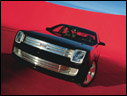
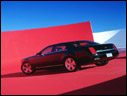
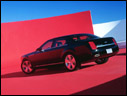
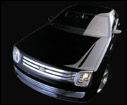
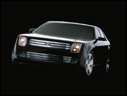
The 1960s were the heyday of the truly cool American car; a time when slabs of sheet metal, chrome and the Rat Pack defined cool. Those days have given way to multi-purpose vehicles, pop-idols and plastic. But, Ford is signaling a renaissance in the classic American sedan with the new Ford 427 concept introduced at the North American International Auto Show.
The Ford 427 concept is a showpiece of the possible design direction for a future lineup of Ford cars. It debuted at the 2003 North American International Auto Show as part of Ford’s biggest-ever wave of new product and concept introductions, nine of which are cars.
The 427 concept is a modern, all-American sedan inspired by the exuberance of the company’s landmark sedans of the 1960s, replete with the uncompromising, 590-horsepower engine that inspired its name.
“This is a car that you take home, park in your driveway, sit back and let your neighbor eat his heart out,” said J Mays, Ford Motor Company vice president, Design. “The 427 concept is unmistakably Ford and 100 percent American. It demonstrates that a sedan from a U.S. manufacturer can once again be exciting, sexy, sophisticated and powerful.”
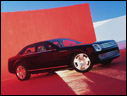
The Exterior – An All-American Design Menacingly blunt in its all-black silhouette with glints of chrome and billet aluminum, the 427 concept is dark and mysterious, day or night. Striking an almost sinister pose wherever goes, the car seems like it was designed for film noir.
“It’s the kind of car that, when you drive it, makes you look like you’re doing something wrong,” Mays said.
To create the 427 concept, Ford designers went back to the blue oval sedans that defined American luxury and performance in the 1960s. They constructed a wish list of elements they felt would be needed to create a modern-day interpretation of the large, family sedan and then incorporated those into a car that would unmistakably be a Ford.
The Ford 427 concept proportions are long, low-slung and wide. The hood, roof and rear deck surfaces are purposefully taut with deliberate graceful transitions. The car’s profile can be described in a single line, flowing crisply through the front fenders and over the roofline before returning on itself in an accelerating sweep into the rocker. This graphical simplicity is emphasized by the use of brushed billet trim to highlight the window line and rocker.
The car’s overall profile is clean, smooth and unfettered by extraneous detail. The front fascia is vertical and linear with a powerful, thick bent bar grille that was inspired by the mid-sixties Galaxie lineup. The front headlamps and rear taillamps are vertical, drawing from the same era but adding modern rounded square cues.
The wheels feature an iconic five-spoke wedge-shaped configuration wrapped with 19-inch rubber. The nomenclature is a modern rendition of the ‘427’ logo that saw use on the Galaxie 500 XL 427. When all of these elements are combined, they cast a silhouette that is unquestionably Ford and unabashedly American.
Even the license plate, with “DET PWR” machined into billet aluminum, articulates the throbbing, made-in-Detroit presence within the 427 Concept.
Detroit Powered “From the first time we drew it up, we knew we had to do a powerplant that lived up to the image of this sinister sedan,” says Chris Theodore, Ford Motor Company vice president, North America Product Development. “Putting a 590-horsepower 427 in this car is like putting a Navy Seal in an Armani suit.”
The modern version of the Ford 427 concept’s power plant started off as a cloak and dagger “skunk works” project commissioned by Theodore, who wanted to know if it was feasible to craft an all-new, lightweight 427 cubic inch (7.0-liter) engine out of Ford’s highly flexible modular V-8 engine family. Ford’s Powertrain Research & Development answered the call and began working under the radar screen on a limited budget. The result shocked everyone.
The 427 engine produces a tremendous 590 horsepower at 6,500 rpm and 509 foot-pounds of torque at 5500 rpm. Remarkably, the engine is almost 70 pounds lighter than the 5.4-liter 32-valve Cobra R engine from the Ford Mustang. The 427 achieves this astonishing power-to-weight ratio through the following attributes:
- Siamese bore aluminum V-10 engine block based on Ford’s modular V-8 DOHC engines
- Ford-pioneered metal spray process to maximize the bore at 95mm
- Newly designed lightweight forged aluminum pistons with a very short compression height
- Aluminum cylinder head derived from the SVT Cobra R Mustang
- New billet H-beam connecting rods and billet steel common pin crankshaft for increased strength without the need for a balance shaft
- Lightweight hollow stem valves
The engine technologies were developed in Ford facilities between Detroit and Dearborn. So, it was only logical to carve the “Powered By Ford” and “V-10” logo with a Redline Red finish on the billet cam covers. Above that, the engineers bolted a massive aluminum strut tower inspired from the grille. As a final touch, they added lightning bolt caps along the inner fender walls.